 Pro Content
Olympic Surfing: The View From the Inside
For his article on the impact of the first ever Olympic Surfing competition in the last issue of Boardsport SOURCE, Dave Mailman reached out to a selection of international industry insiders. We didn’t have space in the print edition to share the full, in-depth list of answers Dave received while doing his research, so we’ve compiled a lightly edited list of his Q&As here, with each answer undoubtedly adding to the ongoing debate over the pros and cons of surfing as an Olympic sport.
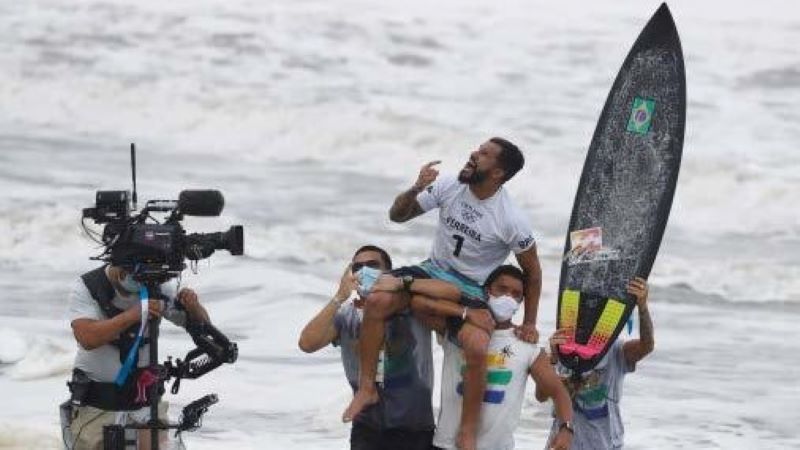
After winning Olympic swimming gold in Sweden in 1912, the father of modern surfing Duke Kahanamoku dreamt of surfing become an Olympic sport. The creator of the iconic Reef Brazil brand Fernando Aguerre finally made the Duke’s dream come true in 2021 in Japan. Boardsport Source reached out to a selection of surf industry veterans for their thoughts on different aspects of Olympic surfing after the Tokyo Games. The following is a selection of their most representative answers compiled by Dave Mailman.
Do you feel any aspect of surfing benefited from its inclusion in the Olympics or not?
Peter Townend (1976 World Champion & President, The ActivEmpire): In September 2016 when the IOC confirmed that surfing would be in the Tokyo 2020 Olympics, I said the man and woman that would win gold would be the most famous surfers in the world just because of the size of the audience that tunes into the Olympics worldwide, and now the digital age of social media has compounded that to the Nth degree. The social media engagement alone of fans and followers was 1.6 billion. So the global exposure to surfing and its culture has been monumental.
Andy Higgins (Marketing Manager, Wavegarden): Everything linked to surfing will be affected by the sport’s inclusion in the Olympics. For the first time in history, the sport received unprecedented coverage and promotion on the global stage. Top athletes were exposed to mainstream audiences like never before, which benefits their own personal brand as well as their sponsors. I’m sure many people weren’t aware of the level of professionalism and athleticism involved.
Ian Cairns (Co-founder, Association of Surfing Professionals): With National Governing Bodies funded locally by Olympic investment, the ISA will further their foundational grass roots youth programmes, an investment in surfing at the local level never before seen. The ISA will evolve towards having Olympic Qualifications without WSL rankings. After the sports world sees Teahupo’o surfing will boom globally. It’s a pivotal time in surfing.
Franck Laporte (Executive Director, EuroSIMA): It’s still too early to judge on a European level. People’s need to get outside and do outdoor sports during the Covid crisis had more impact on the development of surfing and the surf business than the Games. But being an Olympic sport, more people will want to try surfing for the first time.
Stephen Bell (Owner, Euroglass): 100%! This is 2021 and surfing is a household sport for anyone that lives near the beach. Anywhere there’s waves you’ll find surfers, so why not let the world see it? It was a great event and spectacular for all those that never would have seen surfing in any other form. With the next 3 venues locked in for the Olympics, all of which have A-grade quality waves, surfing is here for the long run.
Ed Leigh (Broadcaster & Journalist, BBC): For nations where home athletes are successful there’s always an instant effect, a surge in popularity. But in my experience it’s a long term, residual gain that will manifest in either cultural awareness or physical aspiration, which in time has a positive effect on participation.
Julio Adler (Presenter, Bóia Podcast): Every country now might have federations being fed with state money to train surfers for the Olympics for the first time. Here in Brazil, I heard they used to get around 70,000€ per year and now with the gold medal, it’s ten times more!
Didier Piter (Director & Surf Coach, Hossegor Surf Center): I am disappointed by the general impact for surfing. The qualified surfers definitely gained notoriety and got some good deals with mainstream brands, but nothing compared to what they probably expected… and now that the Olympics are over it’ll quickly be back to the same old thing.
Do you think the Games have had an immediate impact been on surfing’s bottom line (brands, shops, surf schools, wave pools, surfers)?
Peter Townend (1976 World Champion & President, The ActivEmpire): Carissa Moore’s gold medal has put her in another league regarding endorsements. She already had contracts with mainstream companies like Procter & Gamble (Gillette Venus shaver) and Visa and her gold medal winning performance paid her in the millions in bonuses.
Quirin Rohleder (CEO, QR Talent): I represent Leon Glatzer, the sole German surfer qualified and we’re seeing the results already. The Olympics are on a totally different level, especially in Germany. Everyone understands medals. Through the mainstream press we generated he has now short term offers from big companies, which pay really well.
Wilco Prins (Co-owner of Town & Country Europe): Going forward maybe, but this year the Olympics had zero impact on our business. No one has come in and said, “We’ve seen the Olympics and we want to start surfing.”
Jean-Louis Rodrigues (President, EuroSIMA): We’ll see the impact over time, but with respect to the Olympic values it can only be positive.
Andy Higgins (Marketing Manager, Wavegarden): The sport is super attractive and given the amount of promotion it has received, this surely will increase sales in retail apparel, technical products, lessons, and even wave parks.
Didier Piter (Director & Surf Coach, Hossegor Surf Center): Regional bodies will probably have greater decision power for large surf-related projects. It will be good for wave pool development, and local surf tourism efforts.
Ed Leigh (Broadcaster & Journalist, BBC): Outside of nations that delivered medals I believe the effects are negligible.
Have the Games made surfing more mainstream or affected the general public’s view of the sport?
Peter Townend (1976 World Champion & President, The ActivEmpire): Have you seen the Coca-Cola commercial with Mickey Muñoz? Surfers are now Olympians; it doesn’t get more mainstream than that. The commercial is cool, and makes us look cool, but then again surfers have always been cool.
Steve England (Editor-in-Chief, Carve): Coverage was so poor in the UK I don’t think anyone watched it. Skate and BMX were great though and everyone was amped on our teams’ performances.
Quirin Rohleder (CEO, QR Talent): Surfing is such a complex sport most mainstream viewers had a hard time understanding. I commentated for Eurosport. We tried to make it accessible for the mainstream audience, but the feedback afterwards was: “You tried, but I still didn’t understand anything. And the water was so brown, didn’t look nice.”
Ed Leigh (Broadcaster & Journalist, BBC): Not from what I saw and heard from casual viewers. The conditions in the finals lacked surfing’s Holy Trinity: Sun, Sand and Sex. Drizzle, black sand and comp vests undoubtedly dampened its appeal and limited its ability to transcend core fans.
Jean-Louis Rodrigues (President, EuroSIMA): The Games give Olympic sports significance, and an especially positive image on a global level, including for people who know little or nothing about our sport. It’s undeniable.
Andy Higgins (Marketing Manager, Wavegarden): It’s hard to say surfing is still a niche sport given its widespread popularity. It’s fair to say it’s a more mainstream sport than ever before. In terms of the public’s view of surfing, I would think it would be more positive than ever.
Franck Laporte (Executive Director, EuroSIMA): The Games have given surfing recognition as a sport and the athletes will gain from it. Nonetheless, a lot of work needs to be done educating the general public about surfing: the stakes, judging criteria, and manoeuvres.
Was there anything particularly noteworthy or surprising about the competition?
Ed Leigh (Broadcaster & Journalist, BBC): Conditions were perfect for two days after… Running quarters, semis and finals the same day severely limited exposure; the athletes were exhausted and the sport suffered.
Julio Adler (Presenter, Bóia Podcast): It turned out really good, with all the layers it had – small waves, medium waves, judging errors, frustration and glory. At first, I thought it’d be a flop and then I was very entertained.
Andy Higgins (Marketing Manager, Wavegarden): I think the surfers’ attitudes, particularly towards winning a medal were surprising; a medal, no matter which one was of equal or more value than a world title.
Quirin Rohleder (CEO, QR Talent): The increase in athletes’ social media followings was crazy. That’s where you see the Olympics have quite a different pull. Even my 65-year old neighbour in Munich told me she just watched surfing and thought it “was great to have such an exciting new sport in the Olympics.”
How could the competition be improved?
Steve England (Editor-in-Chief, Carve): I really want to see young surfers from across the globe get a chance of qualifying outside of the usual pros on the WCT. Everyone loves an underdog, or a success story, but those stories are being stifled.
Franck Laporte (Executive Director, EuroSIMA): The stakes of this sport practiced in nature, ocean and wave conditions, line-up placement, heat strategy, manoeuvres and judging all need to be explained better.
Jose Gregorio (Country Manager, Boardriders Portugal): Better waves would help for sure, extreme action also. Priority, long waits, 2 surfers in the water, all that is boring for the mainstream.
Julio Adler (Presenter, Bóia Podcast): Maybe more teams, or surfers – 3 instead of 2 per country.
What will happen in Tahiti if there is a major swell event?
Jean-Louis Rodrigues: How will surfers not at the WCT level going to handle Teahupo’o if it’s big? I fear for the safety of certain athletes if it’s giant. Nothing would be more negative than a serious accident happening. The media coverage would be catastrophic for our sport. I said as much to the members of the committee that came to visit different potential contest sites for 2024 before they chose Teahupo’o.
Steve England (Editor-In-Chief, Carve): Tahiti is major spanner in most countries’ National Governing Body’s grassroots qualification and training pathway; it doesn’t make sense. You want to train young surfers to qualify in marginal conditions and then throw them in major Teahupo’o?
Quirin Rohleder: Move it to the beach break at Papara? I guess the photos and the footage will go around the world; people will say, “That looks nice: blue water and palm trees!“ On the other hand, somebody might die…
Didier Piter (Director & Surf Coach, Hossegor Surf Center): I think Tahiti could be the catalyst that attracts more mainstream interest and curiosity about surfing.
Jose Gregorio (Country Manager, Boardriders Portugal): Fans want to see blood. The more dangerous, the more radical, the more extreme the more attention you get.
Julio Adler (Presenter, Bóia Podcast): Shock and awe.
Should future Olympic surfing events be run in wave pools?
Olivier Cuissot (Co-Owner, The Farm): Having a predetermined start time and wave quality turns it into figure skating. But that can help democratize the sport and get more people to start surfing. It would also make it easier to understand. Olympic surfing should be in a pool to completely level the playing field.
Steve England (Editor-In-Chief, Carve): Snow and now skate and BMX engaged audiences. The public understands gymnastics and ‘air style’ comps. They don’t get people sitting in an ocean waiting, four man priority, and two-foot surf. So, that’s the way you’ve got to go.
Didier Piter (Director & Surf Coach, Hossegor Surf Center): Yes, for the show aspect. Consistent waves and no dead time could take surfing to a whole new dimension.
Quirin Rohleder: The general feedback from mainstream viewers was, “You should have it in a pool to be able to compare rides.” I think we should have it in the ocean as long as possible, but if Germany is hosting we’ll have to find a good format for the pool.
Franck Laporte (Executive Director, EuroSIMA): No. Ocean knowledge is an important part of surfing that should be maintained in the competition and explained to the public.
Ed Leigh (Broadcaster & Journalist, BBC): Not unless you want to completely change the face of competitive surfing. Wherever you put the medals the funding will follow; the WSL as a viable world tour at actual breaks would become even more financially challenged. Maybe have a wave pool medal as another surfing medal, so it leaves host cities with a surfing legacy? But if it’s either or it would be a death knell for the dream tour as we know it.
Do you have any last words?
Steve England (Editor-In-Chief, Carve): Surfing is so much more than the Olympics. As I’ve always said the beauty of what we do is that on any given day any surfer of any ability can feel like a gold medallist. It’s the most uniquely addictive activity you can come across. You know what pro surfers do when they retire? They go surfing.
Quirin Rohleder (CEO, QR Talent): When we were commentating the prize giving, I had a tear in my eye. I’ve known Fernando for a long time and it was amazing to see him succeed. Also, the athletes were blown away, even Leon. They had a reception for him in Frankfurt where they called him out onto the balcony of the town hall and hundreds of people were cheering.
Franck Laporte (Executive Director, EuroSIMA): The Olympics mean professional surfers are now regarded as athletes. But there will always be different aspects of surfing, and its counter-culture spirit will live on. Each person will decide what they want to get out of surfing, which sits at an intersection between elite sport, art form, pastime, and lifestyle.