 Pro Content
NIKE, Inc. Reports Fiscal 2022 First Quarter Results
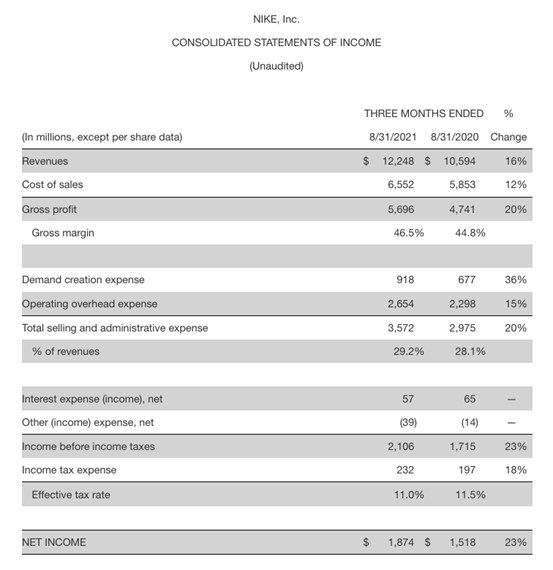
First quarter reported revenues were $12.2 billion, up 16 percent compared to prior year and up 12 percent on a currency-neutral basis, led by NIKE Direct growth of 25 percent. Contributing to NIKE Direct growth was the steady normalization of owned physical retail, which grew 24 percent, exceeding pre-pandemic levels from the first quarter of fiscal 2020. NIKE Brand Digital business continued strong growth, increasing by 25 percent, led by North America growth of 43 percent.
John Donahoe — President and Chief Executive Officer
“Q1 was another strong quarter for NIKE with revenue growth of 16%. And even as we saw physical retail traffic return across much of the portfolio, digital continued its momentum with 25% currency-neutral growth led by North America at over 40%. At the end of the quarter, the summer sport gave way to back-to-school season. So far this fall, we’ve seen sell-through in our kids business up almost 30%, led by digital with growth of almost 70. The new LeBron James innovation center here at our world headquarters. at over 750,000 square feet, this new home for our innovation teams
Even as physical retail revenue approach pre-pandemic levels, our digital business this quarter grew double-digits. This is the result of an unwavering focus on our strategy and the investments we’ve made against our end-to-end digital transformation. And so we continue to expect digital to be our leading channel for growth in fiscal ’22.
Our membership strategy is working as we increasingly use data and analytics to personalize member product offering and experiences. And we’re seeing this come to life as repeat buying members grew more than 70% in the quarter.”
Matthew Friend — Executive Vice President and Chief Financial Officer
“Our first quarter results proved again that our strategy is working and NIKE’s Consumer Direct Acceleration is fueling the transformation of our long-term financial model.
Our relentless focus on serving the consumer translated into revenue growth of 16% and EBIT growth of 22% versus the prior year. Consumer demand for NIKE, Jordan and Converse remains incredibly high and our first quarter financial results would have been even stronger if not for supply chain congestion resulting in lack of available supply.
Digital is increasingly becoming a part of everyone’s shopping journey and we are well positioned to reach our vision of a 40% owned digital business by fiscal ’25.
First quarter financial results and operating segment performance. NIKE Inc revenue grew 16% and 12% on a currency neutral basis with growth across all marketplace channels. NIKE Digital grew 25% and NIKE owned stores grew 24%. Wholesale grew 5% in the quarter, negatively impacted by lower available inventory supply due to worsening transit times. Gross margin increased 170 basis points versus the prior year, driven primarily by higher NIKE Direct margins and partially offset by increased ocean freight surcharges.
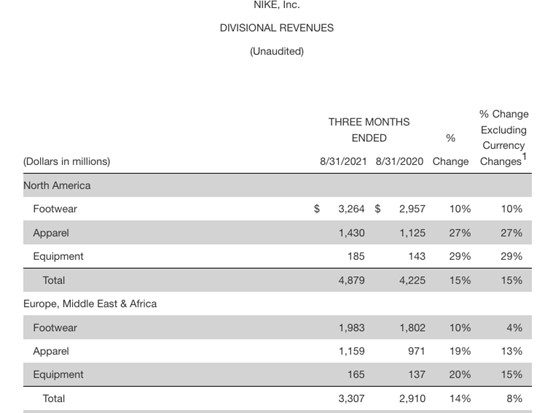
In EMEA, Q1 revenue grew 8% on a currency neutral basis and EBIT grew 26% on a reported basis. Following a full reopening, we saw traffic increase by double digits versus the prior year, with better than expected conversion rates. In EMEA, while NIKE Digital grew 2% in the quarter, demand for full-priced products grew nearly 30% as we compared to higher liquidation levels in the prior year. NIKE owned inventory declined 14% on a reported basis with closeout inventory down double-digits. Transit times to EMEA have also deteriorated over the past 90 days, causing higher levels of in-transit inventory and negatively impacting product availability to serve strong consumer demand.
Previously, I had shared that we were planning for transit times to remain elevated for the balance of fiscal ’22. Unfortunately, the situation deteriorated even further in the first quarter with North America and EMEA seeing increases in transit times due primarily to port and rail congestion and labor shortages. Additionally, several of our factory partners in Vietnam and Indonesia were required to abruptly cease operations in the first quarter. As of today, Indonesia is now fully operational, but in Vietnam nearly all footwear factories remain closed by government mandate. Our experience with COVID related factory closures suggests that reopening and ramping back to full production scale will take time. Therefore, we’re revising our short-term financial outlook to incorporate the following factors: 10 weeks of production already lost in Vietnam since mid July. Factory reopening to occur in phases beginning in October with a ramp to full production over several months and elevated transit times consistent with where we are now operating today.
We now expect fiscal ’22 revenue to grow mid single digits versus the prior year versus our prior guidance of low double-digit growth due solely to the supply chain impacts that I just described. Specifically for Q2, we expect revenue growth to be flat to down low-single digits versus the prior year as factory closures have impacted production and delivery times for the holiday and spring seasons. Lost weeks of production combined with longer transit times will lead to short-term inventory shortages in the marketplace for the next few quarters. And for the second quarter, we expect gross margin to expand at a rate lower than the full year due to higher planned airfreight investment for the holiday season.
Prior to the pandemic, it would have taken approximately 40 days to move product from Asia to North America. Transit times have been increasing due to container shortages, port congestion, rail congestion and labor shortages, impacting the entire industry. And during Q1, these lead times worsened further to now sit at 80 days, roughly 2 times normal. So while the environment is dynamic, these supply chain issues we believe are temporary and from what we can see today, we’re optimistic that available inventory supply will be improved as we head into fiscal year ’23.
Second thing we’re seeing is the expansion of the definition of sport, whether that’s in the Olympics with sports like skate being included for the first time, some of the most exciting moments in the Olympics was around skate. Right? And that young generation, Gen Z generation really dominating remarkably in a very compelling way, but also coming out of the pandemic, the definition of sport I think is getting to every athlete aspirates in different ways. Just the concept of movement and health and the fact that sports can happen in your living room, as well as going to the gym or the yoga studio or the basketball court. And so part of the tailwind we’re seeing is sport is becoming part of everyone’s everyday life. And that’s a powerful tailwind for us.”
Read the full statement here.